


Switch to:
 EN
EN
The global aviation sector is currently bracing for an operational stress test of historic proportions. The 2026 FIFA World Cup, co-hosted by the United States, Canada, and Mexico, represents a massive expansion of the traditional tournament structure, featuring 48 international teams competing in 104 matches across 16 geographically dispersed cities.1 Generating an anticipated influx of over six million international visitors across a 39-day period, the event will effectively overlay the logistical equivalent of multiple concurrent Super Bowls onto North America’s already saturated airspace infrastructure.1 For the global corporate elite, international diplomats, and ultra-high-net-worth (UHNW) individuals attending the tournament, the commercial aviation network will be structurally incapable of providing the agility and efficiency required.5 Consequently, the utilization of private aviation is no longer being framed as a luxury expenditure, but rather as an empirical financial necessity driven by the opportunity cost of executive time.

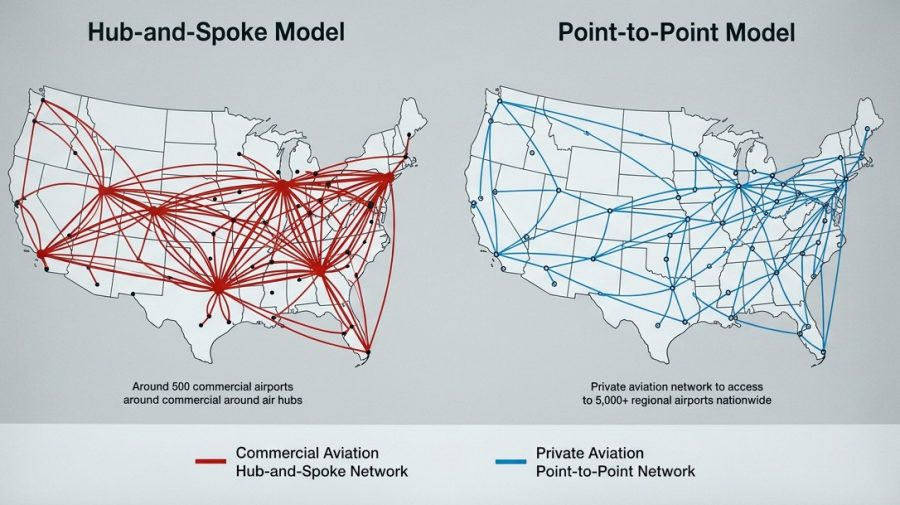
To accurately comprehend the economic dynamics of private aviation during a mega-event, one must first quantify the value of the passengers occupying the cabin.5 Time remains the singular non-renewable resource in corporate operations. Recent financial analyses establish the median time value of a Chief Executive Officer within the S&P 500 at approximately $5,262 per hour. When applying this precise metric to the severe logistical friction inherent in modern commercial air travel, the financial justification for chartering private aircraft becomes a mathematical certainty. The commercial airline industry operates predominantly on a hub-and-spoke model, which restricts travelers to roughly 500 viable commercial airports within the United States, necessitating complex layovers and rigid schedules. By contrast, the private aviation sector operates on a point-to-point model, granting direct access to over 5,000 regional and executive airports, allowing corporate flight departments to deposit executives exponentially closer to their final meeting locations or stadium venues.5
The inefficiencies of commercial aviation are most acutely felt during the pre-boarding and security screening phases, which will be radically magnified during the World Cup. Data aggregated from the Transportation Security Administration (TSA) indicates that under baseline operational conditions, major domestic hubs experience significant screening delays. For example, Newark Liberty International Airport (EWR) averages a wait time of 23.1 minutes, George Bush Intercontinental Airport (IAH) averages 19.8 minutes, and Miami International Airport (MIA) averages 19.6 minutes.7 However, these baselines fail to account for the systemic shock of mega-event passenger volumes. During partial staffing shortages and peak travel surges, hubs such as Hartsfield-Jackson Atlanta International Airport (ATL)—which will host a critical semi-final match—have been forced to issue warnings to passengers regarding security lines stretching into terminal hallways, with wait times extending up to three hours.9 For a corporate executive valued at $5,262 per hour, a three-hour delay standing in a commercial terminal equates to an active hemorrhaging of over $15,700 in lost corporate productivity before the aircraft has even taxied.5

Private aviation circumvents this commercial gridlock entirely. Executives utilizing Fixed Base Operators (FBOs) are shielded from mass transit security apparatuses, typically arriving at the tarmac just 15 minutes prior to their scheduled departure.5 The elimination of commercial check-in counters, standard TSA screening lines, rigid boarding zone procedures, and baggage claim carousels generates a massive reclamation of productive hours. Industry data demonstrates that private aviation saves between two to five hours per flight segment compared to commercial travel, effectively eliminating an average of 127 minutes of wasted time per individual leg.5
The following table models the projected time savings and the resulting financial return on investment for an executive attending three distinct group stage matches via commercial first class versus a private jet charter.
| Logistical Phase | Commercial First Class (Estimated Time) | Private Aviation / FBO (Estimated Time) | Net Time Reclaimed (Per Leg) | Financial Value Reclaimed (@ $5,262/hr) |
| Pre-Flight Arrival & Check-In | 120 – 180 Minutes (World Cup Peak) | 15 Minutes | 105 – 165 Minutes | $9,208 – $14,470 |
| Security Screening (TSA) | 45 – 180 Minutes (Hub Dependent) | 0 – 5 Minutes | 40 – 175 Minutes | $3,508 – $15,347 |
| Boarding & Taxi Procedures | 30 – 45 Minutes | 10 – 15 Minutes | 20 – 30 Minutes | $1,754 – $2,631 |
| Disembarkation & Baggage | 30 – 60 Minutes | 5 – 10 Minutes | 25 – 50 Minutes | $2,192 – $4,385 |
| Total Cumulative Impact | 225 – 465 Minutes | 30 – 45 Minutes | 3.25 – 7.0 Hours | $17,101 – $36,834 |
Data aggregated from TSA wait time projections, private aviation boarding metrics, and executive compensation indices.5
When a corporation utilizes private aviation to transport an executive team across a multi-city tournament itinerary, the cumulative time saved per flight segment ranges between 3.25 and 7 hours. For an executive flying a moderate schedule of 300 hours annually, utilizing a conservative estimate of 1.5 hours of logistical time saved for every hour flown, that individual reclaims 450 hours of productive time—the equivalent of 18.75 full working days.5 By circumventing the commercial system, a single executive effectively reclaims roughly $2.4 million in productive value over the course of a year. This calculation does not even factor in the qualitative, yet highly lucrative, benefits of absolute privacy. A private cabin allows entire corporate teams to safely discuss sensitive mergers, acquisitions, or proprietary business development strategies in the air without fear of corporate espionage, an environment entirely impossible to secure in a commercial first-class cabin.
Furthermore, the demographics of the private flyer are undergoing a profound structural shift, moving away from legacy corporate ownership toward younger, utility-focused consumers. Industry data from operators and brokers reveals that the share of private aircraft buyers and charter clients under the age of 45 has nearly doubled over the last decade, reaching a record 29%.[5, 5] A significant 42% of these younger buyers hail from the rapidly expanding entertainment and technology sectors. These highly affluent Millennials and Gen Z entrepreneurs approach private aviation differently than their predecessors; they prioritize extreme flexibility, seamless digital booking integrations, and the concept of “bleisure”—the seamless blending of business obligations with luxury leisure travel.[5, 5] For this rising demographic, a private jet is not viewed as a static status symbol to be parked in a hangar, but rather as a vital, utilitarian tool required to manage a hyper-connected, high-speed lifestyle.

As the 2026 World Cup approaches, the record growth of private aviation—which logged an astounding 3.9 million global flights in 2025—points to a broader realization across the corporate ecosystem.[5, 5] Outspending competitors on direct travel costs through private charter is frequently the most cost-effective strategy to protect a company’s ultimate asset. When measured against the severe inefficiencies of commercial hubs struggling to process millions of soccer fans, the premium paid for an FBO departure is rapidly offset by the preservation of executive capital.
The Geography of Endurance: Routing, Distances, and the Tarmac Footprint of the 2026 World Cup
The sheer geographic scale of the 2026 FIFA World Cup introduces a logistical complexity that renders traditional sports tournament travel models entirely obsolete.1 Historically, mega-events have been confined to highly compact geographic footprints. The 2022 World Cup in Qatar, for instance, allowed fans and teams to operate within a localized radius where the maximum distance between the eight host stadiums was a mere 50 miles.13 In stark contrast, the 2026 iteration spans an entire continent, stretching across four time zones and encompassing three sovereign nations.14 The distance between the northernmost host city, Vancouver, and the southernmost, Miami, spans approximately 4,375 kilometers (2,718 miles), necessitating a transcontinental flight of roughly six hours. For corporate sponsors, media conglomerates, and ultra-high-net-worth fans attempting to follow their respective national teams, the tournament will require an endurance-level commitment to aviation logistics.13
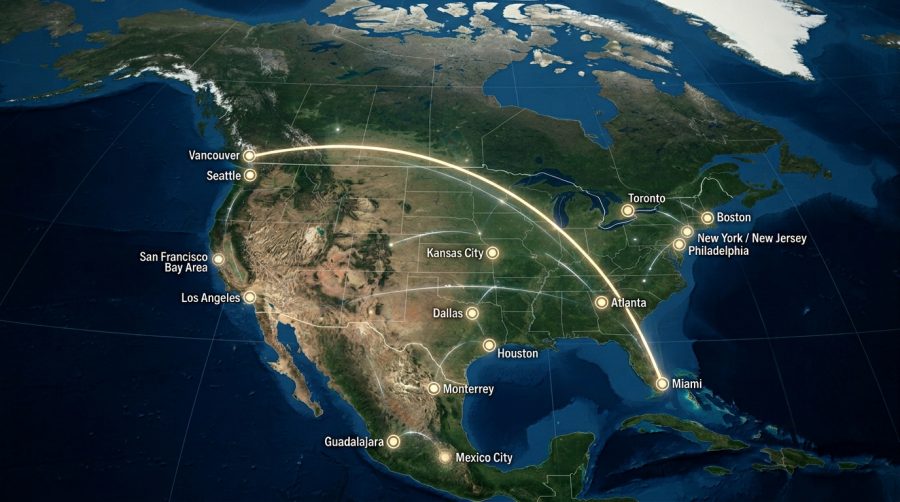
The official group stage draw has generated highly disproportionate travel burdens, transforming the tournament into a lottery of geographic friction.18 Analytical modeling of the group stage schedules reveals a massive disparity in required flight hours based solely on group assignment.18 Teams and fans situated in the Northeast Corridor (Group I) will experience the most manageable logistical environment. A route connecting Boston, New York, and back to Boston requires a cumulative group stage travel distance of only 1,161 miles, zero international border crossings, and benefits from highly efficient regional transit infrastructure.18
Conversely, delegations assigned to Group J are subjected to what analysts have termed “coast-to-coast chaos.” A routing scenario encompassing San Francisco, Kansas City, and Dallas forces these teams to traverse 6,424 miles—an increase of over 450% in travel distance compared to Group I.18 The physical toll on athletes and the logistical nightmare for their support staff are unprecedented. Teams such as Cape Verde and Uruguay, both situated in Group H, face the highest individual travel burdens of the entire tournament.20 Their itineraries force them to navigate a sprawling web connecting Atlanta, Miami, Houston, and Guadalajara.20 This routing requires an estimated 4,500 to 4,700 kilometers of travel and roughly 9.5 to 10 hours of flight time during the brief group stage alone.20
The following table illustrates the extreme geographic variance and projected travel distances for selected national teams during the 2026 World Cup group stage.
| National Team | Group Assignment | Example Routing Network | Total Distance (km) | Est. Flight Time | Logistical Burden |
| Cape Verde | Group H | Atlanta → Miami → Houston → Guadalajara | ~4,700 km | ~10.0 Hours | Extreme |
| Uruguay | Group H | Atlanta → Miami → Guadalajara | ~4,500 km | ~9.5 Hours | Extreme |
| Scotland | Group C | Boston → New York → Miami | ~4,000 km | ~8.5 Hours | High |
| Colombia | Group K | Houston → Mexico City → Atlanta | ~3,300 km | ~7.0 Hours | High |
| Egypt | Group G | Los Angeles → Seattle (Localized) | ~195 km | < 1.0 Hour | Minimal |
Data synthesized from World Cup 2026 group stage distance modeling, flight time analytics, and official match schedules.19
To navigate these extreme distances with the necessary speed and privacy, corporate flight departments and charter brokers will rely heavily on the ultra-long-range business jet category.23 However, the physical dimensions of these flagship aircraft introduce a secondary logistical crisis: the tarmac footprint.25 As thousands of private aircraft converge on the 16 host cities, the physical ramp space at Fixed Base Operators (FBOs) will become the ultimate scarce resource.3
The ultra-long-range market is currently dominated by two engineering marvels: the Gulfstream G650ER and the Bombardier Global 7500.25 While both provide unparalleled luxury and ranges exceeding 7,500 nautical miles, their physical footprints are massive.23 The Gulfstream G650ER features a wingspan of 99.6 feet, an exterior length of 99.7 feet, and an exterior height of 25.7 feet. The competing Bombardier Global 7500 is geometrically larger, designed to offer four true living spaces, a full-size kitchen, and a dedicated crew suite.24 To accommodate these amenities, the Global 7500 boasts a wingspan of 104 feet and a total aircraft length of 111.2 feet.32

When FBO managers utilize specialized ramp management software to geometrically pack aircraft onto limited concrete, these dimensions are critical. An FBO ramp that can comfortably accommodate eight mid-size jets (such as the Citation X) may only be able to fit three Global 7500s due to required wingtip clearance regulations.
The following table compares the physical footprints and operational specifications of the two dominant ultra-long-range aircraft utilized by UHNW travelers.
| Aircraft Specification | Gulfstream G650ER | Bombardier Global 7500 | Operational Implication for Ramp Packing |
| Exterior Length | 99.7 ft (30.4 m) | 111.2 ft (33.9 m) | Global 7500 requires 11.5 ft of additional linear parking depth. |
| Wingspan | 99.6 ft (30.4 m) | 104.0 ft (31.7 m) | Global 7500 requires broader lateral wingtip clearance zones. |
| Cabin Volume / Zones | 1,669 cu ft / 3-4 Zones | 2,637 cu ft / 4 True Zones | 7500 offers superior interior luxury at the cost of exterior bulk. |
| Max Takeoff Weight | 103,600 lbs | 114,850 lbs | Both exceed the 100,000 lb strict weight limit at Teterboro (TEB). |
| Maximum Range | 7,500 Nautical Miles | 7,700 Nautical Miles | Both easily execute direct intercontinental flights to any host city. |
Data aggregated from Gulfstream and Bombardier manufacturer specifications, aviation broker technical guides, and FBO operational limits.24
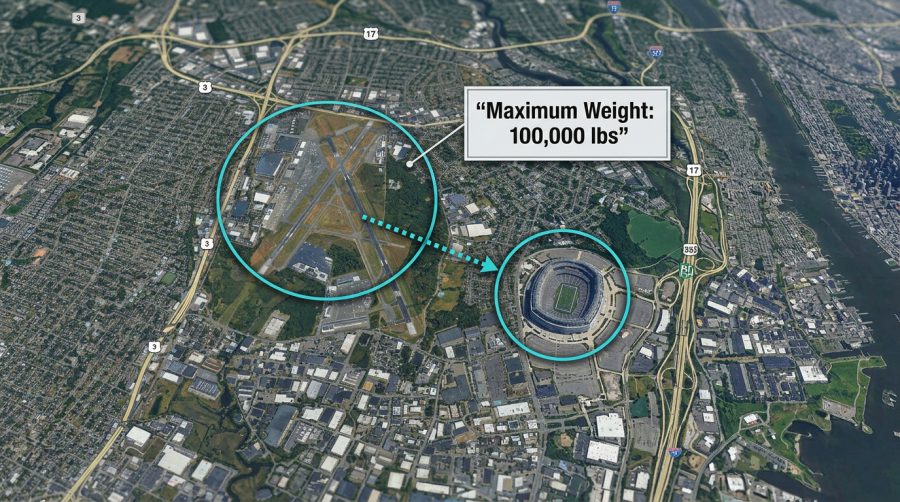
The pressure generated by these massive footprints will climax during the World Cup Final on July 19 at MetLife Stadium in East Rutherford, New Jersey.2 The primary executive gateway for this venue is Teterboro Airport (TEB), situated a mere 5.5 miles from the stadium.38 However, TEB maintains a strict, non-negotiable maximum weight limit of 100,000 pounds for any aircraft operating on its surfaces.38 Both the Gulfstream G650ER (103,600 lbs MTOW) and the Bombardier Global 7500 (114,850 lbs MTOW) exceed this limit when fully fueled.
Consequently, owners of these ultra-long-range flagship aircraft will be barred from utilizing the most convenient airport for the World Cup Final. Instead, they will be forced to utilize secondary airfields such as Newark Liberty (EWR), Morristown (MMU), or Westchester County (HPN), subjecting executives to the very ground transport delays and commercial airspace congestion they sought to avoid.4 For the aircraft that are legally permitted to land at TEB, the 408 acres of aeronautical space will be entirely saturated, leading airport authorities to mandate immediate “drop-and-go” protocols.3 Aircraft will be forced to disembark their passengers and immediately take off again to find parking in adjacent states, transforming the North American airspace into an unprecedented, continent-wide game of logistical chess.
The Regulatory Minefield: Navigating Cabotage, Customs, and Cross-Border Logistics
While securing a private aircraft and a parking reservation at an FBO requires significant capital, navigating the international legal architecture of the 2026 World Cup requires masterful regulatory execution.4 Because the tournament is co-hosted by three sovereign nations—the United States, Canada, and Mexico—the movement of passengers is subject to a highly fragmented, tripartite system of aviation law, customs enforcement, and airspace management. For private jet crews and charter brokers, the primary legal threat is the strict enforcement of cabotage regulations.3
Cabotage is the transport of goods or passengers between two points within the same country by a foreign-registered aircraft operator.44 It is an economic protectionist measure designed to prevent foreign airlines from undercutting domestic carriers within their home markets.44 During a multi-city tournament where corporate delegations and fans wish to follow their teams across borders and between domestic host cities, cabotage laws become a severe operational barrier.3
In the United States, the Department of Transportation (DOT) and the Federal Aviation Administration (FAA) maintain distinct rules depending on the classification of the flight. Foreign-registered private aircraft operating under non-revenue rules (Part 91)—where the aircraft is owned by the individual flying and no compensation is exchanged—are generally permitted to discharge, take on, and transport passengers between U.S. cities. Canada enforces a similar posture; the Canada Border Services Agency (CBSA) applies no cabotage restrictions for private, non-revenue operations provided the owner, their guests, or employees are aboard and the flight is strictly uncompensated.3
However, Mexico presents a profoundly complex and restrictive regulatory environment, serving as the primary bottleneck for North American aviation logistics.4 The Mexican civil aviation authority, the Agencia Federal de Aviación Civil (AFAC), strictly enforces cabotage laws with severe penalties, including exorbitant fines and the immediate grounding and impounding of the offending aircraft. While private, non-revenue flights are technically exempt from Mexican cabotage restrictions, operators are legally mandated to carry formal, notarized documentation detailing the exact personal or corporate relationship between the passengers and the aircraft operator to prove no illicit commercial transaction occurred.
For commercial charter operations (Part 135), the Mexican regulations are draconian. Foreign charter operators are permitted a maximum of only one stop in Mexico (excluding mandatory technical stops or security screenings) to embark or disembark paying passengers. Crucially, a foreign charter aircraft is strictly prohibited from picking up passengers in Mexico unless that exact same operator originally transported those specific passengers into the country.
This regulatory framework destroys the viability of dynamic routing. A European or American charter broker cannot legally fly a VIP client into Mexico City for the opening match on June 11, wait on the ground, and then fly that same client domestically to Guadalajara or Monterrey for their next match. Such an itinerary constitutes illegal cabotage. To comply, international operators will be forced into highly inefficient maneuvers: they must drop their clients at the initial Mexican host city, reposition their aircraft empty out of Mexican airspace, and force their clients to secure secondary, Mexican-registered charter aircraft to transit between the domestic venues.3
Recognizing this capacity constraint, domestic entities are already maneuvering to monopolize the market. Mexicana de Aviación, managed by Mexico’s Defense Ministry, has proactively applied to the U.S. DOT for a foreign air carrier permit to operate cross-border charter flights specifically targeting the World Cup demand surge, proposing a “Logistics Phase” linking host hubs like Dallas, Houston, and Los Angeles directly to Mexican venues.46
The following table summarizes the cabotage and regulatory environment for business aviation during the 2026 World Cup across the three host nations.
| Jurisdiction | Non-Revenue (Private) Regulations | Commercial Charter (Part 135) Regulations | Operational Friction Level |
| United States | Allowed to carry passengers domestically without restriction. | Strictly regulated under DOT foreign air carrier permits. | Moderate (Primarily Slot Controlled) |
| Canada | Allowed if owner/guests are verifiably uncharged. | Cabotage strictly prohibited; no domestic point-to-point. | Moderate to High (CBSA Scrutiny) |
| Mexico | Exempt, but requires formalized proof of passenger relationship. | Strict one-stop limit. Cannot pick up unless originally dropped off. | Extreme (AFAC Permit Delays) |
Data sourced from North American cabotage restrictions, AFAC permit guidelines, and CBSA enforcement protocols.3
Beyond cabotage, operators must navigate rigorous customs and airspace management protocols.4 All general aviation flights entering the United States must comply with U.S. Customs and Border Protection (CBP) mandates, specifically the Advance Passenger Information System (APIS).4 The eAPIS manifest serves as the virtual representation of the flight, and operators are strictly liable for transmitting accurate biometric and passenger data within tight pre-departure timelines.47 In Mexico, AFAC permit processing is already experiencing variable timelines, and charter authorizations are typically issued on a “one-shot” basis, meaning any last-minute schedule changes by the client invalidate the permit and require restarting the bureaucratic process from scratch.4
Once legally permitted in the airspace, aircraft face intense Traffic Management Initiatives (TMI) dictated by the FAA.48 To prevent mid-air congestion over stadiums, the FAA will institute Ground Delay Programs (GDP) and strict Expect Departure Clearance Times (EDCT).48 Aircraft must depart within an unforgiving five-minute window of their assigned EDCT.48 To maintain systemic integrity, the FAA has explicitly stated that no airborne IFR (Instrument Flight Rules) filing or airborne changes of destination will be accepted within 200 nautical miles of the host regions.48 Pilots must file flight plans at least 6 hours, but not more than 24 hours, prior to departure.48 This rigid framework entirely eliminates the spontaneity that typically defines private aviation, forcing corporate flight departments to operate with the rigidity of scheduled commercial airlines.
The Economics of Scarcity: FBO Special Event Fees, Empty Legs, and Real Estate Arbitrage
The severe operational friction and regulatory constraints of the 2026 World Cup will catalyze profound economic anomalies across ancillary luxury markets, transforming scarcity into a highly lucrative arbitrage opportunity.50 As the supply of ramp space, aircraft availability, and premium accommodations evaporates, Fixed Base Operators (FBOs), aviation brokers, and ultra-luxury real estate owners are implementing aggressive pricing architectures to capitalize on the inelastic demand of the ultra-wealthy.
The primary battleground for aviation capital will be the tarmac itself.3 To manage the influx of aircraft and maximize revenue, FBOs across North America routinely institute “Special Event Fees” during peak periods. This phenomenon, often referred to as the “Super Bowl Effect,” is well documented. Historical data demonstrates the massive volume spikes associated with championship events: the 2023 Super Bowl in Arizona triggered a record 931 private jet departures post-game; the 2024 Las Vegas event recorded 882 jets; and the 2025 New Orleans game saw 611 arrivals prior to kickoff. Because the World Cup encompasses 104 matches, this Super Bowl-level congestion will be sustained continuously for six weeks across 16 cities.2
To cover the costs of increased staffing, security, and the sheer premium of concrete space, FBOs are quoting astronomical event fees for 2026. However, an analysis of these fee structures reveals a highly coordinated financial mechanism utilized by the industry: the fuel waiver threshold. Across multiple major venues, operators can only waive exorbitant facility and handling fees by purchasing massive quantities of aviation fuel, typically set at a rigid baseline of 940 to 942 gallons.
In Miami, which will host the high-profile third-place match, operators face handling fees of $3,670, overnight parking rates of $2,642, and an additional 7% airport fee. The handling fee is solely waived if the aircraft uplifts the mandatory 940 gallons. Similarly, Boston mandates a $5,550 handling fee (waived with 940 gallons), coupled with landing, Massport, and security fees. Philadelphia presents the most hostile financial environment, instituting a non-waivable $5,248 special event fee, plus a $2,624 facility fee that triggers the 942-gallon waiver requirement.
The following table projects the financial exposure and fuel waiver thresholds at key World Cup aviation hubs.
| Host City Airport | Base Handling / Facility Fee | Required Fuel Uplift for Waiver | Non-Waivable Event / Parking Fees | Financial Risk Profile |
| Miami (MIA/OPF) | $3,670 | 940 Gallons | $2,642 (Overnight) + 7% Airport Fee | Severe |
| Boston (BOS) | $5,550 | 940 Gallons | $555 (Landing) + $218 (Massport) | High |
| Philadelphia (PHL) | $2,624 | 942 Gallons | $5,248 (Special Event) + $502 (Landing) | Extreme |
| Seattle (SEA/BFI) | $3,172 | 940 Gallons | Dynamic / Unconfirmed | Moderate to High |
| Vancouver (YVR) | $1,200 | 3,000 Liters (~792 Gal) | $1,435 (Overnight) + Security Fees | Moderate |
Data aggregated from confirmed special event fee structures and FBO operational mandates.
This fuel waiver strategy forces flight dispatchers into complex mathematical calculations regarding structural weight limits. Purchasing 940 gallons of fuel (approximately 6,300 pounds) is physically impossible if the aircraft lands with nearly full tanks. Operators must purposefully fly into host cities with artificially low fuel reserves—a practice known as reverse-tankering—simply to possess the physical tank capacity to absorb the required fuel uplift and avoid the financial penalties.
The combination of drop-and-go mandates, cabotage restrictions, and parking unavailability will inadvertently flood the market with “empty leg” flights.3 An empty leg occurs when a private jet is repositioned without passengers to return to its home base or to accommodate its next scheduled full-fare charter. Historically, empty legs account for roughly 40% of all business aviation traffic, and operators frequently sell these deadhead flights at steep discounts ranging from 30% to 75% of the standard charter rate.51 While digital marketplaces market these as cost-effective travel hacks, industry experts warn that empty legs are inherently volatile.58 During the World Cup, as teams face unexpected elimination and delegations rapidly alter their travel plans, the underlying full-fare charters will shift constantly.58 If the primary client cancels, the corresponding empty leg evaporates instantly, making them a highly unreliable logistical gamble for fans attempting to guarantee stadium arrival.58
Simultaneously, the convergence of global wealth is causing a profound destabilization of the ultra-luxury real estate and short-term rental (STR) markets.50 With six million expected attendees and a finite supply of five-star hotel inventory, the demand for premium residential accommodations has surged.4 Platforms like Airbnb are aggressively courting inventory, offering a $750 reward to new hosts who list entire homes in eligible World Cup zones prior to the tournament.62
In Los Angeles, which will host eight matches at SoFi Stadium including the highly anticipated United States Men’s National Team opener on June 12, nightly rates for private luxury villas have skyrocketed.64 Premium estates in neighborhoods such as Beverly Hills and Malibu are commanding between $4,000 and $20,000+ per night.66 Data indicates that booked Airbnb rates for the June 12 opening match are already up 56% compared to a typical summer baseline, with specific single-family properties adjacent to the stadium leaping from a standard $1,000 for a two-night stay to over $10,000.65
The epicenter of this real estate inflation will occur in the New York/New Jersey area during the World Cup Final in mid-July.2 Wealthy attendees eschewing standard hotel accommodations are targeting expansive Hudson Valley estates and Manhattan penthouses.67 While the median rent for a luxury doorman apartment in Manhattan reached a record $5,295 per month in early 2026, the short-term rental market for the World Cup is operating on a different scale entirely.69 High-end properties and luxury villas in the region are listing for $18,000 to $25,000 per week, with final match week hospitality packages commanding extreme, undisclosed premiums.68 For context, purchasing real estate on Manhattan’s “Billionaires’ Row” currently requires an average of $3,231 to over $10,000 per square foot, yet even these UHNW property owners are positioned to capitalize on the unprecedented short-term yields the tournament will generate.71
The following table contrasts the projected inflation of luxury residential real estate against the baseline costs of accommodations during the tournament.
| Host Region | Standard Luxury STR Baseline | World Cup Peak Pricing (June/July 2026) | Market Catalyst |
| Los Angeles (Beverly Hills/Malibu) | $1,000 – $2,500 / Night | $4,000 – $20,000+ / Night | 8 Matches at SoFi Stadium; USMNT Opener 64 |
| New York / New Jersey | $5,000 – $8,000 / Week | $18,000 – $25,000+ / Week | World Cup Final at MetLife Stadium 68 |
| Hudson Valley (NY Estates) | $1,500 / Night | $5,000+ / Night | Privacy demands; easy reverse-commute to MetLife 67 |
Data aggregated from luxury real estate market forecasts, AirDNA analytics, and STR pricing models for the 2026 FIFA World Cup.64
Ultimately, the 2026 FIFA World Cup is not merely a sporting event; it is a macroeconomic catalyst that will ruthlessly expose the capacity limits of North American infrastructure. As the supply of airspace, ramp concrete, and luxury housing remains inelastic against a tidal wave of global capital, the entities capable of executing flawless, data-driven logistical arbitrage will reap unprecedented financial rewards.
Frequently Asked Questions (FAQ)
What is the travel distance for the worst 2026 World Cup group stage routes?
Teams and fans assigned to Group J will face a “coast-to-coast chaos” routing covering 6,424 miles with highly complex transit access.18 Additionally, teams like Cape Verde in Group H face extreme travel burdens of approximately 4,700 kilometers, navigating between cities like Atlanta, Miami, Houston, and Guadalajara.20
How much time does flying private actually save compared to commercial travel during major events?
Private aviation saves an average of two to five hours per flight segment. By avoiding commercial terminals and utilizing Fixed Base Operators (FBOs), executives can arrive just 15 minutes prior to departure, reclaiming up to 127 minutes of wasted time per individual leg.5
Why can’t ultra-long-range jets land at Teterboro Airport (TEB) for the World Cup Final?
Teterboro Airport (TEB), the closest executive airport to MetLife Stadium, enforces a strict weight limit prohibiting aircraft exceeding 100,000 pounds maximum gross weight for takeoff.40 Fully fueled ultra-long-range flagship jets like the Bombardier Global 7500 (114,850 lbs MTOW) and the Gulfstream G650ER (103,600 lbs MTOW) exceed this legal limitation.
What are the cabotage rules for foreign business jets operating in Mexico during the 2026 World Cup?
For commercial charter operations, Mexico strictly enforces cabotage laws, permitting foreign charter operators a maximum of only one stop in Mexico to embark or disembark paying passengers. Furthermore, passengers cannot be picked up unless that exact same operator originally transported them into the country.