

Switch to:
 EN
EN  Português (PT)
In under 24 hours, the global landscape can shift drastically, turning routine travel into a critical emergency due to the sudden closure of airspace caused by armed conflicts, devastating natural disasters, or emerging health crises.
It is exactly in this operational vacuum, where time is the most valuable factor, that the need for an agile rescue imposes itself. Much more than an air taxi platform, Flapper acts as your definitive strategic rapid response partner. With access to a global network of aircraft and a team specialized in highly complex missions, we organize repatriation flights anywhere in the world, ensuring the fast and safe extraction of corporate teams, diplomats and citizens, overcoming the greatest barriers to bring them back home.
Private aviation as the frontline in global crises
The effectiveness of private aviation in high-risk areas isn’t merely theoretical; it has been tested and proven during recent historical milestones. Following the abrupt closure of global borders in 2020 due to COVID-19, the commercial aviation system collapsed, paralyzing over 90% of the world’s airline networks. In this unprecedented scenario, aircraft chartering took center stage in rescuing stranded citizens across multiple continents.
More recently, in the face of the rapid escalation of geopolitical tensions in Eastern Europe and the Middle East, the closure of commercial airspace occurred, in many cases, in a matter of hours. Whether in global health crises, acute political instabilities or severe natural disasters, the premise remains unchanged: when conventional infrastructure paralyzes, private aircraft chartering ceases to be a luxury and becomes the only viable way of return.

The hidden complexity of a repatriation flight
Facilitating a repatriation flight in crisis scenarios transcends the simple chartering of executive jets or a commercial airplane; it requires agile logistical engineering that is almost always invisible to the passengers. The real challenge is concentrated behind the scenes, where it is necessary to quickly overcome strict regulatory barriers and security restrictions in zones of high instability.
In the private aviation industry in times of crisis, one of the most complex obstacles is the negotiation of War Risk Insurance (War-Risk Insurance). Even if the aircraft has a global policy, insurers may suspend coverage for zones that enter into sudden conflict.
Beyond emergency policies, the real challenge lies in the collapsed infrastructure: obtaining diplomatic overflight authorizations in closed airspaces and overcoming the local shortage of supplies. In many cases, it may be necessary to carry out tankering operations — where the aircraft takes off carrying fuel for the round trip —, in addition to coordinating a highly precise ground operation to prevent the crew from exceeding legal duty limits in the middle of the risk zone.
It is a critical operation of international coordination, designed to facilitate precise air repatriation routes, transforming the chaos of a restricted airspace into a structured and safe return route.
How Do Repatriation Flights Work?
A repatriation flight is a complex logistical operation whose main objective is to return citizens, employees or diplomats to their country of origin in situations where conventional commercial routes have been interrupted. Unlike a regular flight, it operates under urgency protocols and, often, in restricted airspaces.
There are, fundamentally, two ways to organize this operation:
Government Repatriation (State Assistance)
Organized by embassies or consulates, this modality focuses on mass rescue. Although essential, it often encounters limitations:
- Queues and Priorities: The passenger depends on waiting lists and priority criteria defined by the government.
- Rigid Routes: Flights generally depart from central airports and arrive only at capitals, which can be a problem if the passenger is in a remote area or needs a specific destination.
- Bureaucracy: Response times can be slow due to diplomatic procedures between nations.
Private Repatriation
For companies that need to extract their executives quickly, or individuals seeking immediate safety without relying on government schedules, private aviation is the definitive solution.
Private repatriation works through dedicated chartering, offering critical advantages in times of crisis:
- Immediate Agility: While State flights take days or weeks to be authorized, a private jet can be mobilized in a few hours, departing as soon as flight permissions are obtained.
- Convenience: Private aircraft can land at smaller, closer airfields.
What to do in moments of crisis?
In situations of geopolitical crisis, natural disasters or international travel restrictions, repatriation flights become an essential solution to ensure a safe return to the country of origin. The first step is to maintain contact with the embassy or consulate, monitor official announcements and register your presence for possible inclusion in international repatriation operations organized by the government.
When government repatriation is not available or urgency requires greater agility, the private repatriation flight — carried out through chartering (urgent international charter) — becomes a viable alternative. In these cases, relying on executive aviation, such as Flapper, is fundamental to structuring the operation safely and efficiently. The operation involves connecting passengers to certified operators, organizing overflight and landing permissions, coordinating international air logistics and structuring alternative routes in risk zones. In scenarios of instability, the combination of decision-making agility and strategic planning is what guarantees a safe and effective emergency repatriation.
Flapper’s role in chartering for repatriation flights
Behind the scenes of a successful repatriation flight, agility of response and access to a diverse fleet are decisive. Flapper quickly mobilizes the necessary infrastructure for each scenario, offering everything from the chartering of intercontinental-range executive jets for strategic extractions of smaller groups of people, to large commercial airplanes, ideal for large groups. This tactical capacity allows us to structure repatriation flights with global reach, where we facilitate safe departures from any country — with the exception of Iran —, adapting the operation to geopolitical restrictions.
Medical Repatriation: When the flight saves lives
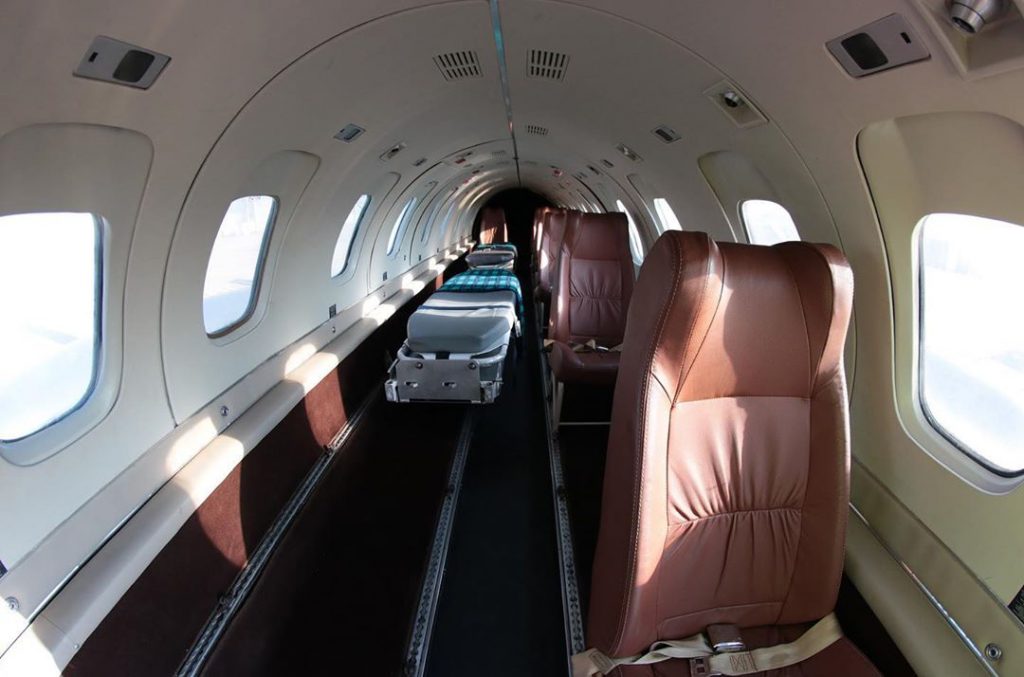
In the context of disasters, crises or serious accidents abroad, Flapper also has extensive expertise in the coordination of medical repatriation flights. For patients in critical condition, the injured or individuals who need urgent treatments in their countries of origin, aeromedical air chartering is the definitive solution. In these cases, private jets are transformed into true flying Intensive Care Units (ICUs). Equipped with advanced life support and crewed by specialized medical teams, these medical repatriation flights ensure an uninterrupted and safe emergency evacuation of highly vulnerable individuals.
Request your flight
In scenarios where every minute counts, relying on a strategic air service makes all the difference between chaos and a successful rescue. You can request a quote through our website or our app. After selecting the desired option, contact our sales team to confirm availability and the final charter price.
We have a multilingual team that speaks English, Portuguese, Spanish, and Russian. Our US legal entity and bank accounts are capable of quickly processing international payments.