

Switch to:
 EN
EN  Português (PT)
If there is one word that defines the Formula 1 Miami Grand Prix, it is exclusivity. The event attracts fans from around the world to the surroundings of Hard Rock Stadium, bringing together the pinnacle of speed, technology, and entertainment.
However, what many spectators fail to anticipate is the biggest and most exhausting rival off the track: South Florida’s relentless traffic.
For those looking to optimize time and secure premium access, helicopter transfers for F1 Miami have become the ultimate logistics solution—and Flapper is your strategic partner at this moment.
The Traffic Chaos Around Hard Rock Stadium
The road infrastructure in Miami Gardens and the main access routes to the stadium, such as the Florida Turnpike, I-95, and local roads like NW 199th Street, experience a severe and immediate impact during race weekend.
The region was simply not designed to absorb the sudden and massive influx of tens of thousands of F1 Miami fans arriving at the same time.
The reality for those traveling by land is harsh: a car journey from areas like South Beach or Downtown, which would normally take around 30 to 40 minutes, can easily turn into a draining marathon of up to 2 hours or more.
Road closures, security detours, police checkpoints, and the natural bottleneck to access parking areas create a true gridlock (total congestion):
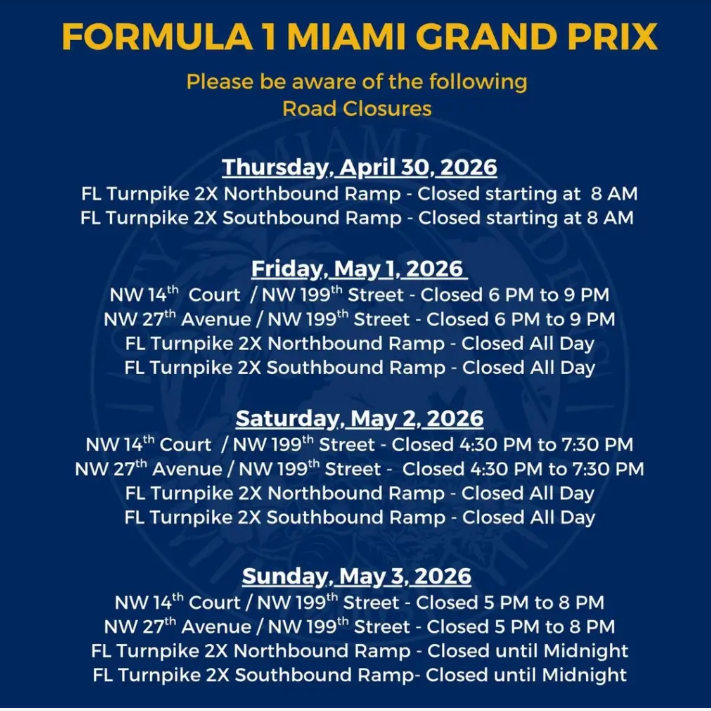
The frustration does not end upon arrival; after the race, fans often report waiting 60 to 90 minutes just to move their car away from the stadium perimeter.
The Efficiency of Air Transfers at the F1 Miami Grand Prix
You’ve invested in exclusive access, premium lounges, and the best hospitality the Miami Grand Prix has to offer. However, it makes little sense to secure the best spot at the circuit if your experience begins and ends with hours of exhaustion stuck in traffic.
It is in this scenario that a helicopter transfer stops being just a convenience and becomes the ultimate way to save your Formula 1 weekend.
By choosing an air transfer, you replace hours of stress stuck in a vehicle on congested roads with a fast, direct flight featuring spectacular panoramic views.
Instead of facing traffic, the helicopter takes you from your point of origin directly to the Miami International Autodrome in a matter of minutes, typically around 10 to 20 minutes.
You leave the comfort of your space, bypass all traffic from above and arrive refreshed, landing directly at the event.
Strategic Takeoff Points
For a helicopter transfer to make sense, it cannot add new, complex steps to your day. The goal of the operation is simple: rapid access, absolute discretion, and zero friction with the urban environment. Therefore, the flight is planned considering strategic takeoff points to be exactly where you are. With rates starting at $2,300, you guarantee your VIP arrival at the F1.
For those already in the city and those arriving from afar
- Miami-Opa Locka Executive Airport (OPF): The number one choice for executive aviation. If arriving by private jet, the helicopter can wait right next to the aircraft at the FBOs (private terminals), allowing for a discreet and rapid transition. The major challenge, however, is that OPF is Miami’s most coveted runway, requiring strict slot approvals (PPR) and exhausting its ramp space well before the event.
- Miami International Airport (MIA): The main gateway for intercontinental flights and the ideal base for large aircraft (Heavy Jets and Ultra-Long Range). Although the airport operates with a high volume of commercial air traffic, its dedicated executive aviation infrastructure features comprehensive customs services and top-tier FBOs.
- Fort Lauderdale-Hollywood International (FLL): An excellent choice for those arriving on domestic or international flights who desire complete support infrastructure. FLL perfectly accommodates jets of all categories, offering premium private terminals (FBOs) and agile customs services.
- Palm Beach International (PBI): Strategic for those who own a residence or are staying further north, in Palm Beach. PBI offers world-class infrastructure, making it the ideal destination to comfortably accommodate large aircraft (Heavy Jets and Ultra-Long Range). Unlike the airports further south, it guarantees greater ramp flexibility, streamlined customs processes, and absolute discretion during boarding and disembarking.
- North Perry Airport (HWO): Stands out as a strategic alternative for those seeking maximum proximity to the stadium (about 7 miles / 11 km) and wishing to avoid the logistical bottleneck of Miami-Opa Locka. Due to its operational profile and infrastructure characteristics, the airport is predominantly geared toward turboprops (such as the King Air and Pilatus PC-12), light jets, very light jets, and helicopters.
- Fort Lauderdale Executive Airport (FXE): Featuring long runways and the capacity to operate all categories of aircraft—from light jets to intercontinental heavy jets—this airport offers premium lounges and can provide U.S. Customs services upon prior coordination. It is one of the premier charter alternatives when slots at Miami-Opa Locka run out, perfectly serving passengers staying in the Fort Lauderdale area or those who will use the base for a helicopter transfer, bypassing highway traffic directly to the racetrack.
- Miami Executive Airport (TMB): Formerly known as Kendall-Tamiami, this airport boasts robust infrastructure and runways long enough to receive everything from light jets to large aircraft (Heavy Jets). It offers dedicated customs and excellent FBOs with considerably less slot pressure than Opa-locka. Although positioned much further south (about 30 miles / 50 km from the event), this distance is easily neutralized by a helicopter arrival.
- Boca Raton Airport (BCT): Positioned north of Miami’s logistical bottleneck. It is the perfect choice for passengers staying in the luxurious areas of Boca Raton, Delray Beach, or Palm Beach, also serving as a premium escape route when southern airports are saturated. Featuring a dedicated U.S. Customs facility, BCT is highly efficient for chartering light jets, midsize jets, and turboprops, offering agile and extremely discreet disembarking. Its distance from Hard Rock Stadium is easily overcome with a helicopter transfer.
- Pompano Beach Airpark (PMP): Positioned as an excellent alternative for clients staying in exclusive properties to the north, such as Hillsboro Beach, Lighthouse Point, and Boca Raton, offering an agile and discreet operation. To bypass the greater ground distance to Hard Rock Stadium, we can structure an integrated solution: the aircraft lands outside the most congested areas, and the passenger proceeds via a fast-connection helicopter transfer, significantly reducing the total travel time.
Slots and Restricted Airspace
The effectiveness and punctuality of a helicopter transfer are intrinsically linked to early planning.
The airspace around the Miami International Autodrome is strictly controlled by air traffic control (ATC), and the availability of landing slots within the event infrastructure is extremely limited.
Therefore, booking flights for F1 Miami cannot be left to the last minute. Scheduling and confirming the service must be done well in advance of the event, ensuring the allocation of flight time and, crucially, secured landing and departure slots at the circuit’s official heliport.
What Are the Advantages of Chartering a Helicopter for F1 Miami?
Executive aviation not only offers convenience, but also solves critical access challenges. Here is the strategic comparison:
- Time Optimization: Direct air transfer from your point of origin.
- Priority Access: Landing in a dedicated heliport zone, strategically positioned adjacent to the Paddock area.
- Superior Comfort: Modern cabins equipped with sound insulation, climate control and panoramic city views.
- Safety Assurance: Strict operations with certified aircraft and approved air carriers (FAA Part 135 standard).
- Operational Flexibility: Strategic pickup and drop-off points at key locations near the stadium.
Safety as a Non-Negotiable Standard
The high demand during the event inevitably attracts unauthorized operators or under-equipped aircraft. By coordinating your transfer through an executive aviation broker, the operation is safeguarded against these risks.
Specialists ensure that the flight is carried out exclusively by air operators that are rigorously audited and certified under Federal Aviation Administration Part 135 standards.
The Role of Flapper as Your Strategic Partner
In this highly complex scenario with limited slot availability, the role of Flapper goes far beyond simply booking an aircraft. We act as end-to-end logistics managers, coordinating the relationship between the client, certified operators and the event’s air traffic control authorities.
End-to-End Management
- We coordinate every stage of the itinerary, from your departure point, whether in Miami Beach, Downtown or the FBO where your jet arrives, to a precisely timed landing adjacent to the Paddock.
Zero Administrative Friction
- We centralize the entire operation. We filter the market, ensure full operational compliance and consolidate all contracts and payments, eliminating any bureaucratic complexity from your side.
Fleet Curation
- In just a few taps on our app or through our Concierge, you gain immediate access to a carefully curated fleet for F1 Miami. We centralize the best aircraft options for you.